

The Microsoft Teams Connector enables you to use Perplexity to search across your Microsoft Teams messages and channels, and send and receive messages without leaving Perplexity. This connector is available to users in all our paid plans – Perplexity Pro, Perplexity Max, Enterprise Pro and Enterprise Max.
Below you’ll find an overview of this Connector and how to activate it.
What does the Microsoft Teams Connector do?
The Microsoft Teams Connector allows you to seamlessly access relevant information from Microsoft Teams directly in Perplexity, and integrate it with information from the web, or other compatible apps and services, without having to shift between platforms.
With the Microsoft Teams Connector, you can also create and send messages on Microsoft Teams. Combined with other app connectors, this allows you to query different sources and share updates in Microsoft Teams directly from Perplexity, saving you time and context-switching.
Privacy and Data Security
The Microsoft Teams Connector requires the following permissions to function:
-
Maintain access to data you have given it access to
-
Read the names and descriptions of teams
-
Read the names and descriptions of channels
-
Read user channel messages
-
Send channel messages
-
Read and write user chat messages
-
Create chats
-
Send user chat messages
-
Read all users' full profiles
-
Read presence information of all users in your organization
-
Have full access to user calendars
-
Have full access to all files user can access
We do not store your Microsoft Teams data. Every time you run a query using the Microsoft Teams Connector, we retrieve only the information that is relevant to answer your query.
Enterprise-grade Security and Control
For Enterprise organizations, we offer enterprise-grade protections and compliance including SOC 2 Type II certification, end-to-end encryption, strict data privacy measures, and granular user access controls. Your Microsoft Teams data, just like any other Enterprise data, is never used for AI training, and robust safeguards ensure confidentiality and regulatory compliance. You can learn more in our Trust Center.
Connecting Perplexity to your Microsoft account is done at a personal level. This means that no one else in your organization is able to query your data. If you query Microsoft Teams on a shared session, however, anyone with access to the session will be able to see the responses.
To maintain control over how Perplexity interacts with Microsoft Teams, organization admins can enable or disable the connector for all organization users.
How to activate it
Admins may need to grant organization-wide consent to the Perplexity app in Microsoft Entra. You can find more information in this article.
To activate the Microsoft Teams Connector:
-
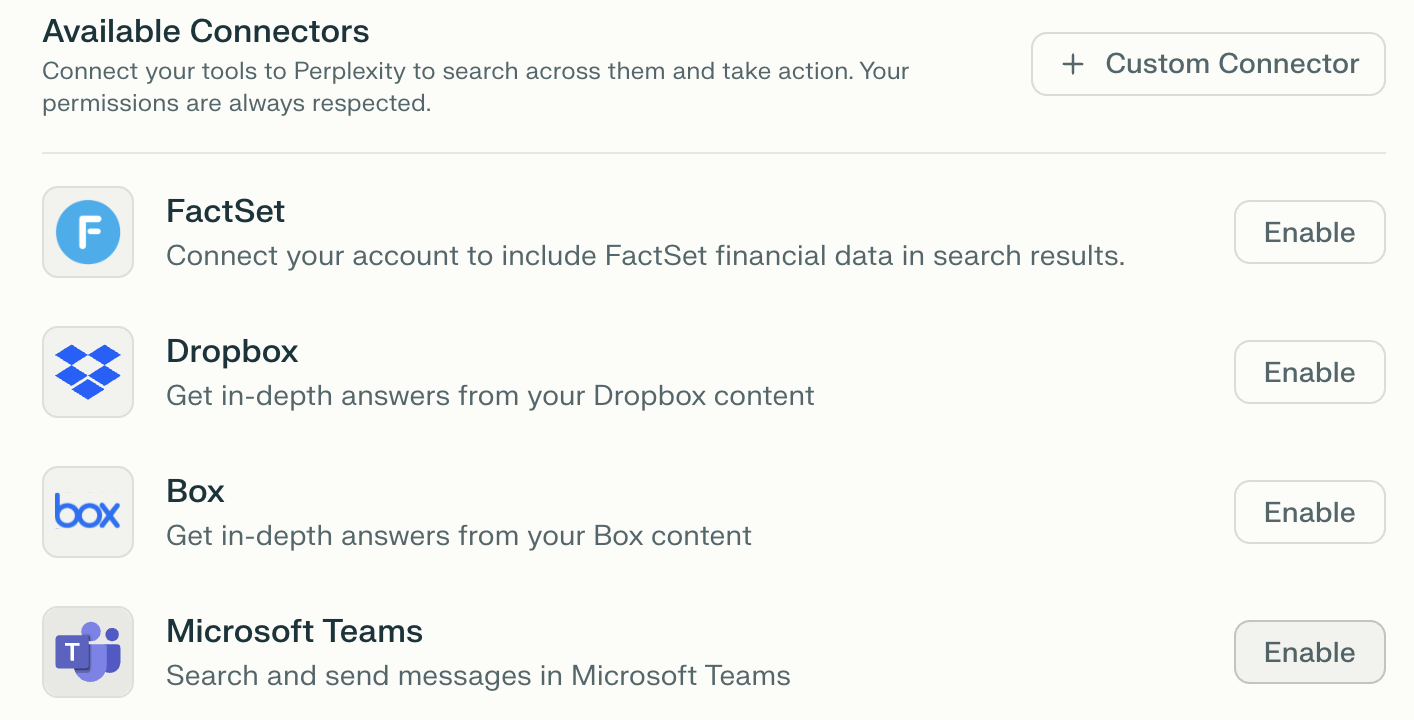
Go to Connectors in Settings and locate the Microsoft Teams Connector on the list.
-
Click Enable, and then click Add Connector in the pop-up that will appear.
-
You will then be prompted to log in to your Microsoft account and to grant some permissions to the connector. Click Allow to continue.
-
Click Finish setup to start using Perplexity with Microsoft Teams.
Trying it out
Once you have connected Perplexity to Microsoft Teams, try running some of these queries to leverage your inbox and calendar information and perform actions in directly from Perplexity:
-
“Summarize today’s important messages from all project channels in Microsoft Teams to help us prepare for tomorrow’s stand-up.”
-
“Identify unresolved questions from Teams meeting chats over the last week, and find the most accurate, recent answers from credible web sources.”
-
“Create a concise Teams channel post summarizing the top three industry updates relevant to our product team, citing sources.”
-
“Fetch the full transcript from the latest Teams meeting, generate a research summary of discussed topics, and post it in the project’s #updates channel.”
-
“Automatically detect sentiment in Teams chat messages and enrich negative conversations with external advice or documentation”
-
“List all new Teams users added this week and attach a short onboarding guide generated with best practices for hybrid work productivity.”